Key Results
Introduction
Two to four hours. That was how long a Solbr lead waited for the first reply on WhatsApp — when service even came on the same day. Today it's 15 seconds. Including 2 in the morning.
Solbr — a solar energy company operating in São Paulo (capital, coast, inland) and Rio de Janeiro — brought in Embed Station to fix it. The result is Noah: an AI agent who lives inside WhatsApp, talks to leads in natural language, simulates the investment using Solbr's actual prices, and hands the sales team a lead that's ready, standardized, and qualified. The team got off WhatsApp duty.
The Challenge
Before Noah, here's how it went: a message comes in on WhatsApp. Could be 2 PM on a weekday, could be Saturday at 10 PM, could be a holiday. If it's during business hours, someone on the team reads it — when they can. There's a customer at a job site, a technician calling, a spreadsheet open, a simulation running in Excel for another lead that came in this morning. Two, three, four hours later, they open the conversation. Ask for the ZIP code. Wait. Ask for the electric bill amount. Wait. Manually calculate the system sizing. Go back to WhatsApp with the proposal. When the message came in outside business hours, no one replied until the next day.
What about nights? Sundays? Nothing. The lead who messaged at nine in the evening waited until nine the next morning — if they still remembered Solbr at all. Most had already requested quotes from three competitors in the meantime.
Solbr had tried solving this with a human. They hired an SDR to cover pre-sales. Took months to find the right person, and even then it didn't stick. When she left, everything went back to Wagner — owner and sales manager — plus the three internal consultants who were already busy closing deals. Solbr's catalog is wide: conventional solar, hybrid solar, BESS, pool heat exchangers, gas water heaters. Over fifteen products total, distributed across a network of consultants covering São Paulo (capital, coast, inland) and Rio de Janeiro. Asking a single human SDR to cover all of that with technical depth was asking the impossible.
And when a lead didn't get answered, the impact didn't stay in sales. A customer waiting hours to schedule a site visit meant idle installers, delayed billing, a disorganized calendar. The slow lead was an operational problem.
From hours of waiting to seconds
Our Approach
Noah isn't a numbered-menu chatbot. Every message from a lead goes through a language model that understands context, transcribes audio (in Portuguese), asks for the ZIP code, automatically detects the local utility company for that city, and runs an investment simulation using Solbr's actual price table — not generic market pricing. When the simulation is done, the agent collects qualification data one item at a time, classifies the lead temperature (cold, warm, hot), and notifies the consultant responsible for that region with a structured summary.
Behind the scenes, Embed Station combined a low-code integrator, an OpenAI language model, conversation memory in Redis, and a custom-built multi-product calculator — with 21 price tiers per panel count, peak sun hours by city, 25-year projection accounting for panel degradation and tariff increases, plus avoided CO₂ calculation. The core piece is that calculator: it's what turns "I want to know how much it costs" into a concrete proposal in seconds, with the same number a human consultant would have spent twenty minutes calculating in Excel.
Tech Stack
You don't need to understand the stack — Embed Station handles that. For transparency, here's what runs underneath:
Map the actual catalog
We took Solbr's pricing spreadsheet and rebuilt the calculator with specific panel models, real tiers, and tariffs by utility.
Build the conversation flow
No menus. Noah reads natural language, combines audio with text, and follows a strict strategy: simulate first, qualify after.
Test until it holds
Real conversations, edge cases (aggressive customer, off-topic, cut-off audio, an unlabeled number that could be R$ or kWh), until Noah could handle Solbr's daily reality.

The Solution
Before, the sales team did everything. Now Noah handles pre-sales and simulation, and the three consultants step in only when the lead is qualified and ready to close.
Replies any time, the same way
2 PM or 3 AM, weekday or holiday, the lead gets the first reply in under 15 seconds. No queue, no "we'll get back to you tomorrow."
Simulates investments with Solbr's real pricing
Noah covers five product categories (Conventional Solar 610W WEG, Hybrid Solar with battery, BESS, Pool Heat Exchanger, Gas Water Heater), detects the utility by ZIP code across ten options, and returns a proposal based on Solbr's actual price tiers — not generic numbers.
Hands the qualified lead to the right consultant
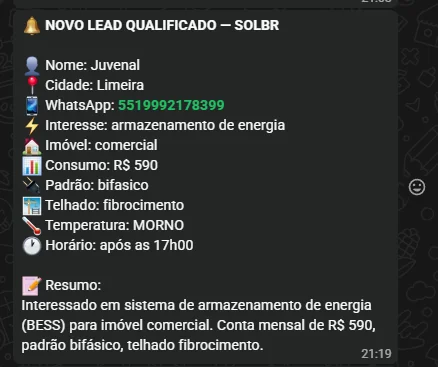
name, property type, roof type, electrical entry, best contact time, lead temperature — all standardized. The consultant gets a structured summary on WhatsApp and opens the conversation already knowing what to offer.
Works in any language
Noah runs in Portuguese for Solbr's Brazilian customers — both text and audio (the screenshots below show real conversations in Portuguese). The same architecture supports English, Spanish, or any language the model speaks — useful if you sell into multiple markets.
Who This Works For
This model fits you if:
- You sell a high-ticket product with a wide catalog (solar energy, financing, insurance, real estate, healthcare plans) that requires case-by-case calculation or simulation.
- Your leads come in through WhatsApp at any hour — including nights, weekends, and holidays.
- Your sales team is spending time on pre-sales that should be going to closing, or you've already tried hiring a human SDR and couldn't keep them.
If that sounds like your operation, Solbr's path is your starting point.
Results and Impact
*Base salary of R$3,000 (≈ $545 USD) for a sales SDR, plus benefits and payroll taxes, totaling around R$5,500/month (≈ $1,000 USD) in full employer cost. Noah eliminated the need to rehire after the previous SDR left.
The biggest difference for the team wasn't just response time. It was what happened to the night. The lead who came in Saturday at 10 PM — who used to be seen Monday morning, if they were still interested — now reaches the consultant with the ZIP code, electric bill amount, roof type, electrical entry, best contact time, and simulation already done. The team opens the conversation knowing what to offer. And the consultants are back to doing what they do best: visiting clients, closing sales, covering the four regions with depth.
WhatsApp Channel Coverage
Conclusion
Two to four hours turned into 15 seconds. Channel coverage went from a third of the week to every day, every hour. The sales team got off WhatsApp duty and went back to selling. The project is in final validation, in controlled pilot, with full operation rolling out in the coming weeks.
But here's what's worth taking with you: if you sell high-ticket products with a wide catalog, and your pre-sales depends on someone who has to be on WhatsApp during business hours to calculate every simulation in Excel — you have the same problem Solbr had. Every lead that comes in at night or on weekends is a lead asking three competitors for quotes while waiting for you to read the message. Most companies that try to solve this by hiring a human SDR find out what Solbr found out: takes months to find the right person, and when she leaves, you're back to square one. What made Noah work isn't just the language model — it's the calculator plugged into real prices. Without that, it's just another chatbot with generic answers.
Run the math on your operation. If you get 2 hot leads per day (60 per month), and 30% come in outside business hours — that's 18 leads per month waiting. If half give up before you reply, that's 9 hot leads per month going to competitors. In residential solar, each proposal is worth R$25,000–R$50,000 (≈ $4,500–$9,100 USD, original BRL converted at 5.5:1 — exchange rate at the time of the case). These are Brazilian residential solar tickets — US tickets typically run higher, so the math scales accordingly. That number is leaking from your funnel right now. You just aren't looking at it.
Next Steps for Solbr
- Build the dashboard for conversation extraction and analysis to feed continuous prompt improvements.
Next Steps for You
30 minutes to map the operation. A few weeks to have the agent running. Measurable results from month two.
How many sales did you lose in the past few months because no one replied — or replied too late?
If you had to open a spreadsheet to even count, this case study is about you.
A free 30-minute diagnostic. You walk away with (1) a map of where your operation is losing leads to delay or absence, (2) the automation paths fastest to apply in your case, and (3) a concrete next step toward having an agent like Noah on your WhatsApp.
If in 30 minutes we can't show you concrete value to automate, we can stop right there.
This isn't a pitch — it's an operational read. We work with what you already use, and we adjust the agent to your operation, not the other way around.
📩 contact@embedstation.com 🌐 embedstation.com